
Episode transcript
Welcome to Korean Slang School: Starter Pack! This is a podcast for Korean learners—especially beginners who have just finished learning Hangul. We learn useful everyday expressions and explore the Korean culture behind them.
If you’d like to hear content entirely in Korean, check out the original Korean Slang School podcast for intermediate and advanced learners. You’ll find the link in the episode description.
Now, imagine this.
You’ve arrived in Korea. You walk into a restaurant, order your food, and hear a few words that sound strangely familiar.
Service? 서비스? Self? 셀프? Sign? 사인?
Wait. Are they speaking English?
Well… kind of.
Korean uses lots of words borrowed from English. Some keep a similar meaning, while others take on a different meaning or become part of a new expression. People often call those Korean-style English expressions “Konglish”—Korean plus English.
Today, we’re putting five useful expressions with English roots into one little travel survival kit.
Konglish Survival Guide for Beginners!
Are you ready?
Number one: “이거 서비스예요.”
You’re eating at a Korean restaurant. Your food has arrived.
Then the owner brings over another plate.
But you didn’t order that.
Did they bring it to the wrong table? Are you going to have to pay for it?
But the owner smiles and says:
“이거 서비스예요.”
That means, “This is on the house.”
In other words: this one is free!
Let’s break it down.
“이거” means “this.”
“서비스” comes from the English word “service.” But here, it means something extra that a restaurant gives you for free.
And “예요” is a polite ending that helps us say something “is” something.
“이거 서비스예요.”
“This is on the house.”
You might receive a free drink with your meal, or a little extra food.
It can happen when you’re shopping, too. A seller might put something extra into your bag and say:
“서비스예요!”
“A little extra, for free!”
If you’re not sure whether something is free, you can turn the same sentence into a question. Just let your voice rise at the end.
Listen to the difference.
“이거 서비스예요.”
“This is on the house.”
“이거 서비스예요?”
“Is this on the house?”
Same words. Different intonation.
Try the question with me.
“이거… 서비스예요?”
And if the answer is yes, what do you say?
“감사합니다!”
“Thank you!”
One small tip: water and basic side dishes are often included with a meal at Korean restaurants. But that doesn’t mean every drink, dessert, or extra dish is free.
If you’re unsure, ask first.
이거 서비스예요?
Number two: “물은 셀프예요.”
Imagine that you have your food. Maybe you even have your free dumplings.
But now you need water.
You look at the table. There is no water.
You look around for a server, and then you notice a sign that says…
“물은 셀프.”
What does that mean? The water is… itself?
That’s strange… let’s break it down.
“물” means “water.”
“셀프” comes from “self,” but in this situation, it means “self-service.”
So “물은 셀프예요” means:
“Water is self-service.”
Or, more naturally: “Please help yourself to some water.”
In some Korean restaurants, you’ll find a water dispenser with cups nearby. Sometimes there’s a fridge with bottles or jugs of drinking water.
You take a cup, get your water, and bring it back to your table.
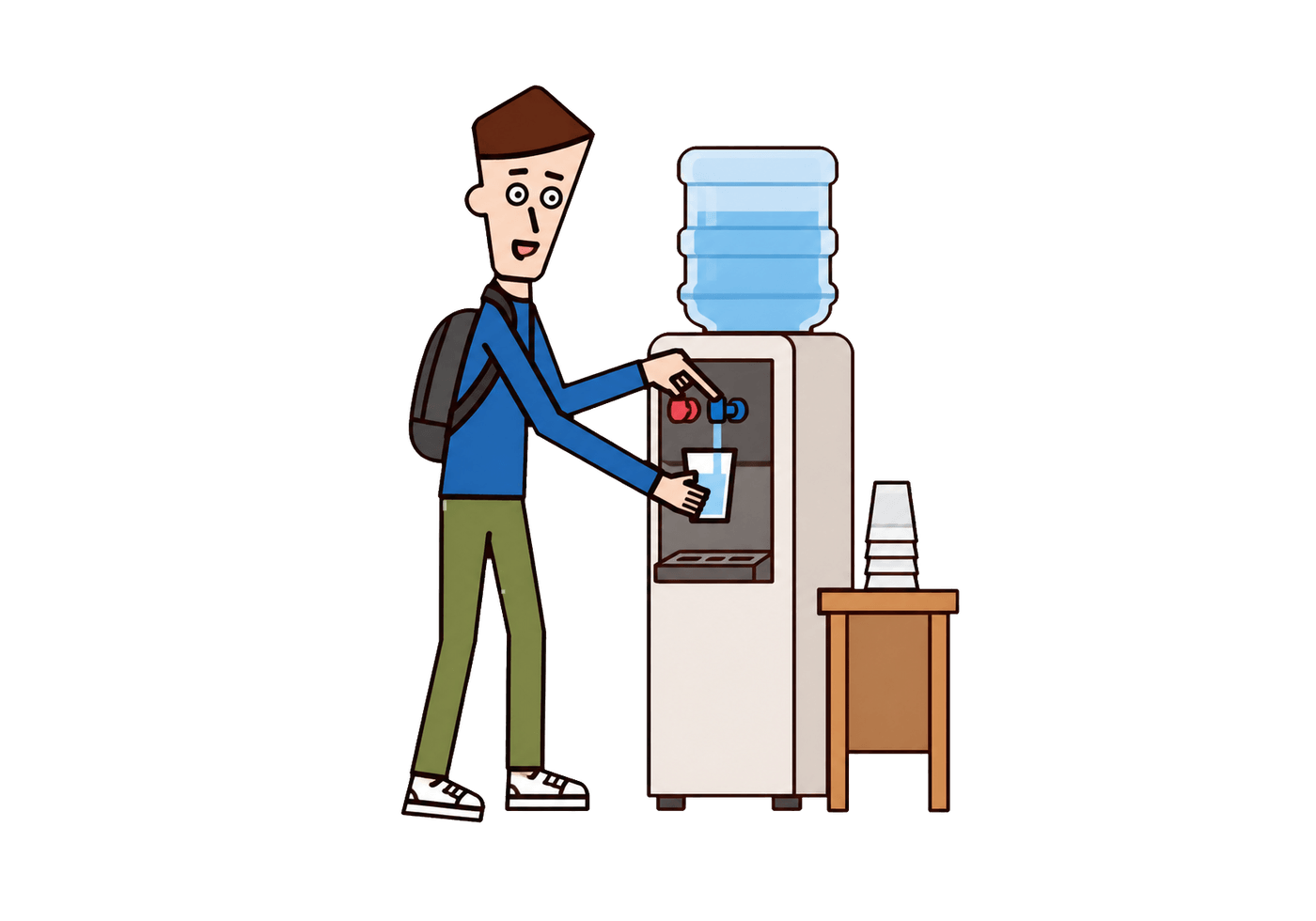
Let’s say the expression slowly.
“물은… 셀프예요.”
You might see it with other things, too.
“반찬은 셀프예요.”
“Side dishes are self-service.”
“반찬” means the small dishes served alongside your meal.
If a restaurant has a self-service side-dish station, which is a small bar with many types of side dishes, you can go over and help yourself. Take a little first—you can usually go back if you need more.
Number three: “카드 돼요?”
You’ve finished your meal. Now it’s time to pay.
You take out your card, but you want to check whether you can pay by card.
Here’s your next survival phrase:
“카드 돼요?”
“Can I pay by card?”
“Do you take cards?”
“카드” is the English word “card,” pronounced in Korean.
And “돼요?” is a very useful Korean expression. Depending on the situation, it can mean “Does it work?” “Is it possible?” or “Is it okay?”
So “카드 돼요?” is like asking, “Does a card work here?”
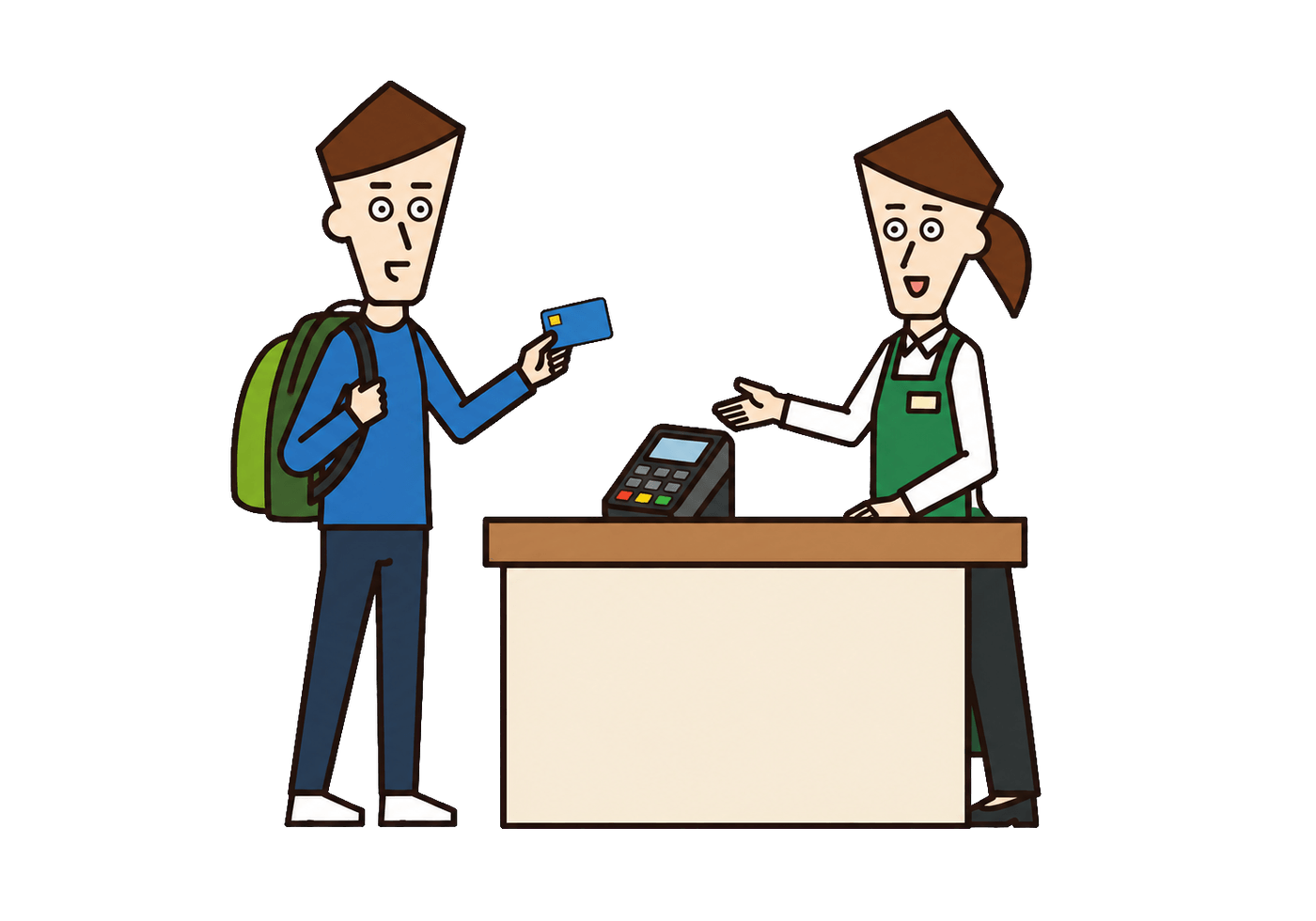
“카드 돼요?”
Let’s try a short conversation.
You ask:
“카드 돼요?”
The person at the counter says:
“네, 돼요.”
“Yes, you can.”
That’s the answer you’re hoping for!
But you might also hear:
“죄송합니다. 카드 안 돼요.”
“Sorry. We don’t take cards.”
Here “안” makes the expression negative.
“돼요.” It’s possible.
“안 돼요.” It’s not possible.
You may also hear the word “현금,” which means “cash.”
“현금만 돼요.”
“Cash only.”
Most restaurants now take cards, but if you want to buy some street food at a market, you might hear 현금만 돼요.
So remember: 카드, card; 현금, cash.
Number four: “사인해 주세요.”
You’re still at the counter. Your card payment is going through, and the person points to a screen or hands you a receipt.
Then they say:
“사인해 주세요.”
“Please sign here.”
“사인” comes from the English word “sign.” In Korean, it can refer to a signature, and “사인하다” means “to sign.”
“해 주세요” means “please do.”
Put them together:
“사인해 주세요.”
“Please sign.”
You may hear a slightly longer version:
“여기에 사인해 주세요.”
“Please sign here.”

“여기에” means “here.”
You won’t need to sign for every card payment, but this phrase can also come up at a hotel or when someone asks you to sign a form.
And here’s a fun little extra.
In Korean, “사인” can also mean an autograph.
If you meet your favorite singer, you might ask:
“사인해 주세요!”
“Please give me your autograph!”
Same expression. Very different situation.
At a restaurant, someone wants your signature to finish a payment.
At a fan event, you want a singer’s signature to keep forever.
Whether you are about to pay at a restaurant or get an autograph from your favorite singer, remember: 사인해 주세요.
Number five: “테이크아웃할게요.”
You’ve finished your meal, paid, and signed. Now, time for a coffee.
You walk into a café and order your drink, and you want to take it with you. What should you say?
“테이크아웃할게요.”
“I’ll get it to go.”
“I’d like it for takeaway.”
“테이크아웃” comes from the English expression “take out.”
And “할게요” means something like “I’ll do that.”
This one is a little longer, so let’s practice it in two parts.
“테이크아웃.”
“할게요.”
Now together:
“테이크아웃할게요.”
We can use it right after the order.
“아메리카노 하나 주세요. 테이크아웃할게요.”
“One Americano, please. I’ll get it to go.”

“테이크아웃할게요.”
That’s it! Easy peasy, lemon squeezy!
You’ve completed your first Konglish survival mission.
Let’s see what you remember.
I’ll give you a situation. Try saying the Korean phrase out loud before I give you the answer.
Ready?
You’re at a restaurant. The owner brings you a free plate of dumplings. What might they say?
“이거 서비스예요.”
“This is on the house.”
Next, you’re looking for water. The server tells you to get it yourself.
“물은 셀프예요.”
“Water is self-service.”
Now you want to pay. You hold up your card and ask…
“카드 돼요?”
“Can I pay by card?”
The person at the counter points to the signature screen and says…
“사인해 주세요.”
“Please sign.”
And finally, you’re buying a coffee to drink on your walk. What do you say?
“테이크아웃할게요.”
“I’ll get it to go.”
Now we’ve got one more Korean phrase packed and ready to use. I hope this survival kit will be useful when you travel in Korea!
You can also find transcripts and vocabulary at krslang.school. Thank you for listening, and see you next time!
안녕!