Episode transcript
한국인이 쓰는 진짜 표현 Korean Slang School 현주입니다. Hi everyone! This is Hyunju from Korean Slang School, where you learn real Korean expressions. Welcome back to the podcast. In this episode, you’ll get cultural insights in English with some Korean expressions. If you’d like to practice listening, you can find the previous episode in full Korean.
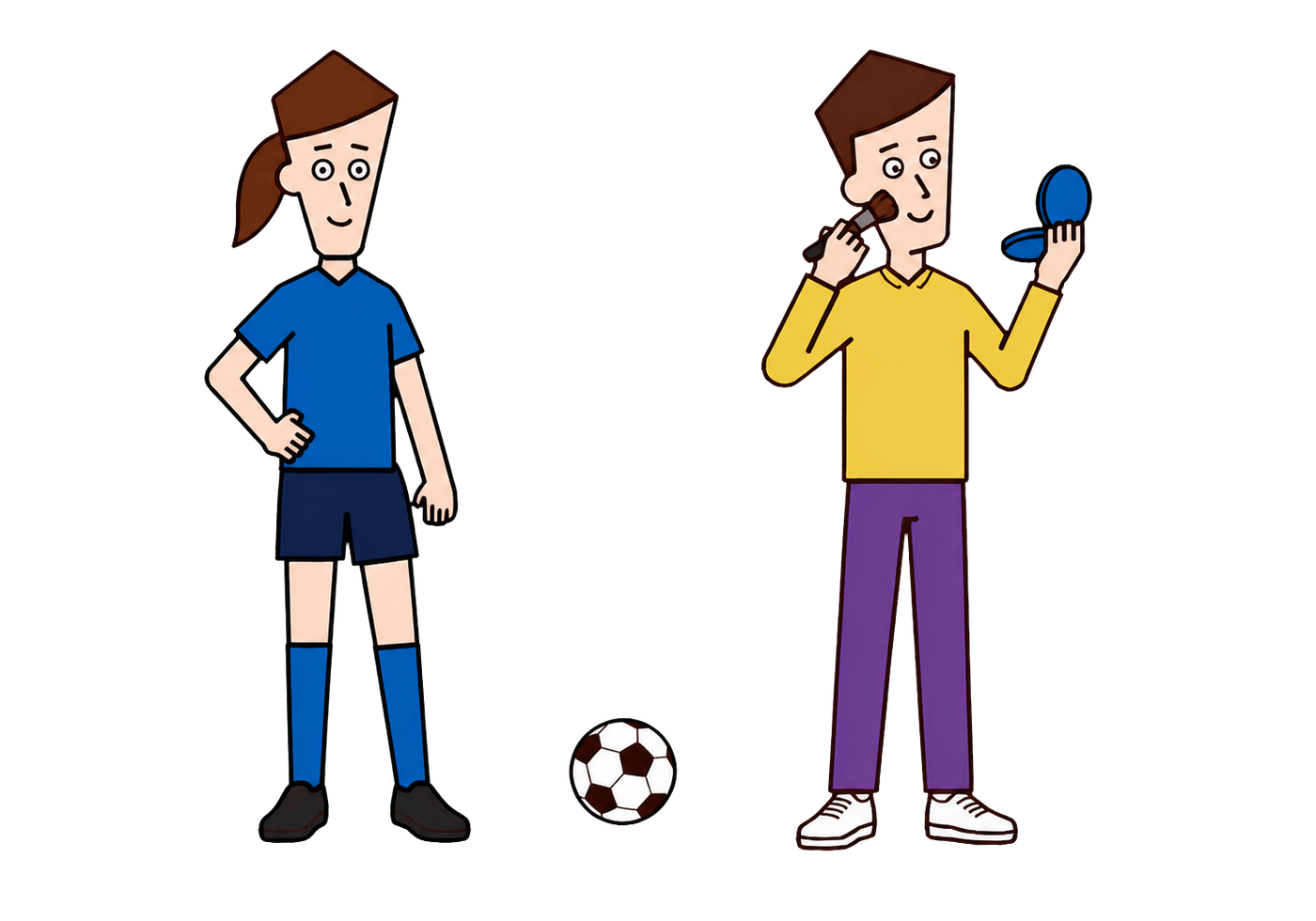
So, have you ever heard the terms “에겐남” and “테토녀”? In Korean, we say 에겐남 (E-gen-nam) for a guy with lots of estrogen, and 테토녀 (Te-to-nyeo) for a girl with more testosterone. In other words, an E-gen-nam is a guy with more feminine traits, and a Te-to-nyeo is a woman with more masculine traits. Of course, we also say 테토남 (Testosterone Guy) and 에겐녀 (Estrogen Girl) to describe masculine men or feminine women, respectively.
Interestingly, this concept has become so trendy that people now take “Estrogen vs. Testosterone” tests instead of MBTI personality quizzes!
So today, we’re going to take this short test to find out whether I am 에겐녀 or 테토녀. You can find it online, and I’ll include the link so you can try it too!
Estrogen vs. testosterone test
Alright! Let’s start. In this test, you’ll hear 10 statements and decide whether you agree or disagree with each one. Based on your answers, you’ll get an estrogen or testosterone result.
-
1 I care a lot about fashion and personal styling. (What about you? I definitely do. I love clothes and accessories, so yes!)
-
2 I enjoy celebrating anniversaries and special events. In Korea, couples often celebrate every 100 days or on their one-year anniversary. (For me, I’m not that into anniversaries... so, nope.)
-
3 I’m good at noticing changes in other people, like new haircuts. (Oh! Actually, I’m the type of person who always notices when friends and coworkers change their look, so yes.)
-
4 I often compare myself to others and feel envious. (Hmm... I do compare, but not often. So no. By the way, if you want to say “I feel envious of you,” you can say “부러워요.” For example, if your friends go on vacation to Korea, you could say 정말요? 부러워요. “Really? I feel envious of you.”)
-
5 I work out more for strength and muscles than for body shape. (I do care about how I look, but I focus more on building muscle and improving my health, so yes.)
-
6 When I like someone, I wait for them to contact me first. (Hmm... not me! If I like someone, I reach out first, so no.)
-
7 I enjoy finding 감성 카페 on Instagram and visiting them. (Here, 감성 카페 means an Instagrammable café. Honestly, I’m not into that kind of thing, so no.)
-
8 I’m very ambitious about my career. (Totally! I want to do my job well and have big goals. In Korean, 욕심 usually means “greed,” but it can also mean “ambition,” depending on the context. 욕심 있어요. So yes!)
-
9 I often worry about what others say. (I do think about what others say sometimes, so yes. By the way, we can say 뭐뭐에 신경 써요, meaning “I care about” or “I worry about” something. 신경 means “nerves,” and 써요 means “use.” Literally, it means “I use my nerves.” For example, 일에 신경 써요 means “I care about work” or “I keep thinking about work.”)
-
10 I enjoy doing things alone, like eating, watching movies, or going to cafés. (In Korea, we call these 혼밥 (eating alone), 혼영 (watching a movie alone), and 혼카 (going to a café alone). I actually like doing things solo, so yes!)
That’s the end of the quiz! I wonder if I am an 에겐녀 or a 테토녀?
Drumroll... I got 테토녀!
How about you? Did you figure out which side you lean toward? If you’re curious, check out the link and take the quiz for yourself!
Why are these tests so popular in Korea?
So, why are these kinds of personality tests so popular in Korea?
Historically, Korea has had strong ideas about what men and women “should” be like, largely because of Confucianism. This led to very fixed gender roles. We call the idea that “men should be this way, and women should be that way” a 고정관념 (go-jeong-gwan-nyeom), or stereotype.
-
고정 (go-jeong) means “fixed” or “unchanging.”
-
관념 (gwan-nyeom) means “idea” or “thought.”
So a 고정관념 is a fixed idea, or in English, a stereotype.
For example:
-
“Women should be good at cooking, have long hair, be emotional, and not too muscular.”
-
“Men shouldn’t cry, should have short hair, and should drive well,” and so on.
From what I’ve seen, even just five years ago, these gender stereotypes were still pretty strong in Korea. But recently, things have been changing.
On TV, we now see female singers, models, and actresses playing football. We also see men wearing makeup. In fact, a survey once asked Koreans to respond to 10 gender-based statements, like:
-
“Men are better at math than women.”
-
“Men have better leadership skills than women.”
Many people disagreed with these statements. That shows us that the old way of thinking is slowly fading.
The terms “테토녀, testosterone girl” and “에겐남, estrogen guy” reflect this shift. In the past, people believed that strong leaders were always men and quiet, emotional people were always women. Now, we’re seeing strong women who are leaders and quiet, emotional men, and it’s becoming more accepted.
Some people even argue that we shouldn’t label people by gender at all. We should see them as strong, emotional, or ambitious individuals, regardless of gender.
In my opinion, the healthiest society is one where stereotypes are broken and everyone is respected just as they are, whatever their personality or appearance may be.
So today, we learned two new Korean slang terms: E-gen-nam and Te-to-nyeo! You can listen to the Korean version in the previous episode to help you practice listening.
I’ll be back next time with more real Korean expressions and stories. 지금까지 한국인이 쓰는 진짜 표현 Korean Slang School 현주였습니다. 안녕